
In South Africa Apartheid’s systematic, purposeful and legislated restriction on the majority of South Africans from meaningful economic participation and where the creation of wealth was confined to a racial minority; the “new” dispensation of 1994 brought with it democratic values, central to which was the premise and constitutional promise of equality for all. Armed with the experiences of an unjust and unequal system of governance, the new political dispensation, of South African society made a break from these ‘weak’ values of inequality to a new state of governance instilled with the highest hopes of democratization. In recognition of the entrenched prejudices, racial and gender discrimination bread into South African society by the pre-1994 political system and which persists as historical attitudes, it is only advertent that a radical transformation of society should be deployed in order to correct the inequalities of the past.
To achieve clarity on the purpose of affirmative action it is essential to evaluate the constitutionality of such a programme. If the affirmative action objective is too explicitly or implicitly cause reverse discrimination based on a scheme of racial qualification, it would then not likely pass the constitutional test. One of the key components that characterize organizations in the twenty first century is the relentless nature of its competitive survival. If International companies want to invest in South Africa, they must take into consideration our laws governing the country.
These organisations must realize if they want to be valued partners and good corporate citizens in this country they should embrace the BBBEE policies. A quick survey of the organizational macro-environment reveals much evidence of conjoining trends that have been combined to create an acute awareness about environmental factors affecting contemporary organizational managers’ strategic thinking. This macro-environment is not only the environment in which organizations function in, but also provides the imputers from which boundless and often uncontrollable factors characterised by economic, socio-political and legal components, that may present opportunities or challenges to organizations.
In light of the rigorous demands from competitive forces that are placed on the competitive market, organizations are further faced with the strategic demands of change in the form of broad ranged state or government legislative policies. Strategies and legalistically inclined initiatives seek to enforce broader social aims of overcoming economic disparities, entrenched inequalities which continue to characterise the economy and act as a deterrent to economic growth, economic development, employment creation and poverty eradication.
The driving forces of change organizations encounter in their socio-political environments can thus, be attributed to broader transformational aims of democratisation, taking place in the South African environment. As a cause this transformation has had a trickle-down manifestation of empirically measurable affect on the organization’s socio-political environment. The social development role of state and government can no longer be seen as disassociated from the broader social aims of organizations, (in the light of corporate citizenship) where the beneficiaries of a sustainable public/private participation in economic development is society at large.
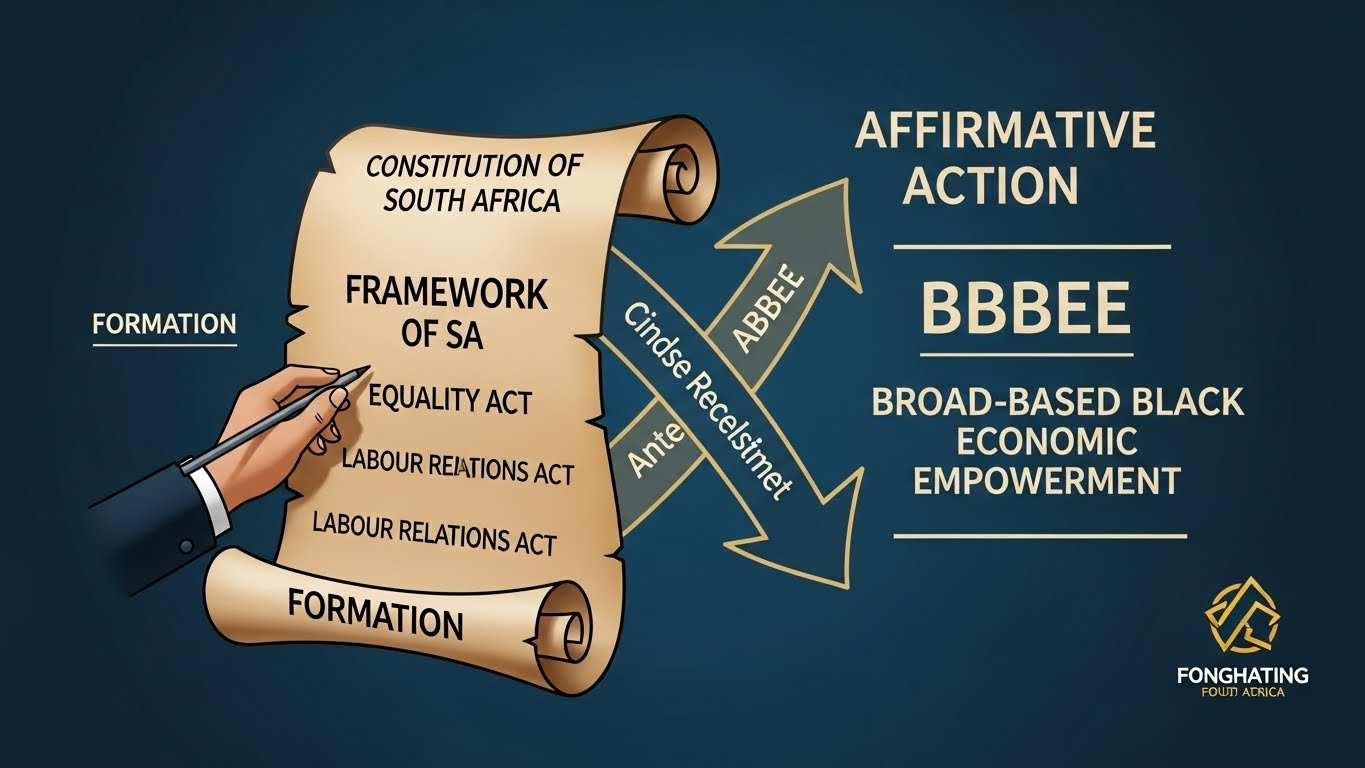
Formation of legislation Framework
The legislative framework for the transformation of the South African economy is enshrined in “the final Constitution of the Republic of South Africa, Act 108 of 1996, the Labour Relations Act of 1995, implemented on 11 November 1996, the Basic Conditions of Employment Act 75 of 1997 and the statute for Employment Equity Act 55 of 1998” (Du Plessis, & Fouche, &, Van Wyk, 2004). The recent changes through the introduction of the above mentioned legislation reveals much in the way of including previously disadvantaged designated groups, which is legally guaranteed by the constitutional right to equal opportunity.
These legislative frameworks make provisions for affirmative action, unfair discrimination and the definition of designated groups which are “Africans, Coloureds, Indians, women and people with disabilities” (Du Plessis, & Fouche, &, Van Wyk, 2004). The implications of these legislative changes in the external legal environments of organizations have thus; become the driving forces of South African organization’s internal changes. Changes in government regulations, in one form or another, have always characterised the external environments of organizations internationally.
What distinguishes the most recent spate of government initiated changes is the non-compulsory and incentives nature of the Broad Based Black Economic Empowerment Act of 2003. This Act may be seen as the most interesting due to the fact that not only does it encompass the evolutionary changes of secondary legislation (which is to say from initial enactment of employment equity to BEE to the current BBBEE), that further supports employment equity, but also gives incentives to corporate social investments strategies, meeting broader social aims.





Leave a Reply